
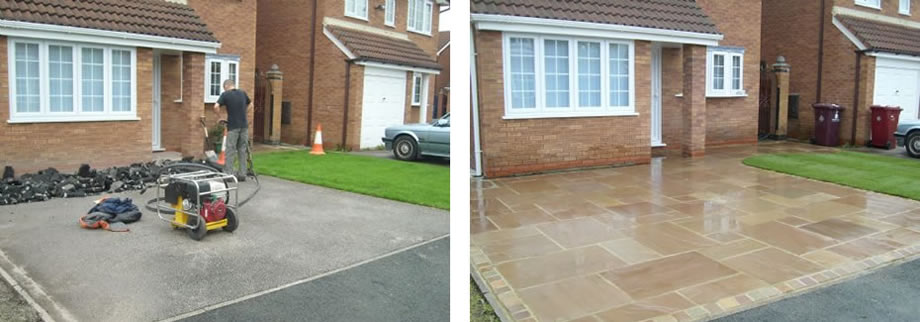
A drive fails at the edges and underneath, not in the colour you picked from a brochure. Three jobs on this site show the usual Hertfordshire choice: tarmac renewed for the Kemptons in Hemel Hempstead, sandstone for Mr Gorden in Borehamwood, and block paving on a steep slope for the Kharnes in Radlett.
Tarmac
Tarmac suits a simple shape and a reasonable fall. It is what many new-town drives were given, and it is what starts to fret and crumble after a couple of decades. Renewing it, as at Hemel Hempstead, makes sense when the levels already work and you want a plain surface rather than a patterned one.
It is a poor choice if you need to hold a steep bank, or if the front garden has to take water somewhere specific. A new tarmac skin on a failed base will look fine until the first hard winter.
Sandstone slabs
Sandstone is the surface clients ask about when they want the front of the house to look finished. On Mr Gorden’s drive the old tarmac was excavated, hardcore was laid and compacted, a block edge was set around the outline, then the slabs went down and the joints were pointed.
The edge is not decoration. It stops the slabs walking, and it draws the line between drive and border. Sandstone wants that discipline. It also wants a fall, so water leaves the surface instead of sitting in the joints and blowing them in a frost.
Block paving
Blocks are the flexible option, which is why they suit the Kharne drive: long, steep, and held by a stone wall and a timber fence. Small units follow a slope and a curve more honestly than large slabs. They can be lifted later if a service underneath needs opening.
They also show every sag in the base. On a hill, the kerb and the retaining wall are doing as much work as the blocks. Budget for those, or the pretty surface will creep.
Front gardens and rainwater
In England, paving more than five square metres of a front garden with an impermeable material can need planning permission if the water does not drain within your own boundary — to a lawn, a border or a soakaway, for example. Permeable materials, or a design that keeps the water on the plot, are the usual way through that rule.
It is a planning point, not a styling point, and it is worth confirming with your council (Hertsmere, Dacorum, St Albans and the others, depending on the town) before a front garden that is currently planted is turned into a full-width drive. We would rather alter the levels on paper than lift a new drive because the water runs into the road.