
South and west Hertfordshire — Elstree, Borehamwood, Radlett, Bushey, Potters Bar — sits largely on London clay. It is a good soil once you stop fighting it. In a wet winter it holds water. In a dry August it cracks. Dig it when it is sticky and you make bricks.
A low maintenance garden is the practical answer, and it is what most of our clients ask for. It does not mean concrete. It means each part of the garden has a job, and the weekly work is a mow, a sweep and a watering can, not a renovation.
Put the hard surfaces where you already walk
Patios, paths and a modest area of gravel belong on the routes you use: out from the doors, down to the shed, across to the bins. On clay, those surfaces need a base and a fall. Water that sits on paving will sit all winter.
The Humpage courtyard is the small version of this. A side return that was bare soil is now sandstone, a brick planter and pots. There is almost no bed to weed. Mrs Antony’s garden in Hertford is the family version: paving and gravel take the level changes, and the lawn is a clear shape you can mow without steering around ornaments.
Keep the lawn, but give it an edge
Children need grass, and a lawn is still the cheapest green surface that recovers if you use it. On clay it fails when it is laid on smeared spoil or left without an edge, so the mower scalps the soil and the grass retreats.
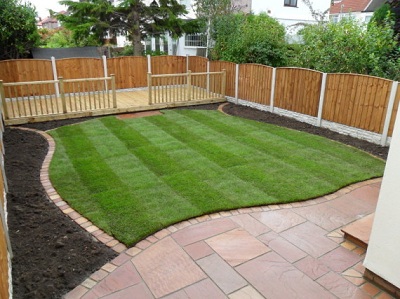
A brick or paved edge, as on the lawn in our design photographs, gives the mower a line and stops the turf collapsing into the bed. If the existing soil is tired, bring in topsoil before the turf. That is what we did on Mr Mason’s garden in St Albans, where the lawn had already half died.
Plant less, and plant what you will actually touch
The borders that get abandoned are the ones too wide to reach and too precious to ignore. A bed you can work from the path, plus pots for anything you enjoy, is enough. Leave the vegetable patch if you like growing things. Drop the shrubbery if you do not.
Busy households do well with a routine rather than a blitz: a mow, a hedge a couple of times a year outside nesting season, and a seasonal tidy. If even that is too much, a monthly maintenance visit is how several of the built gardens are kept, including Mr Mason’s.